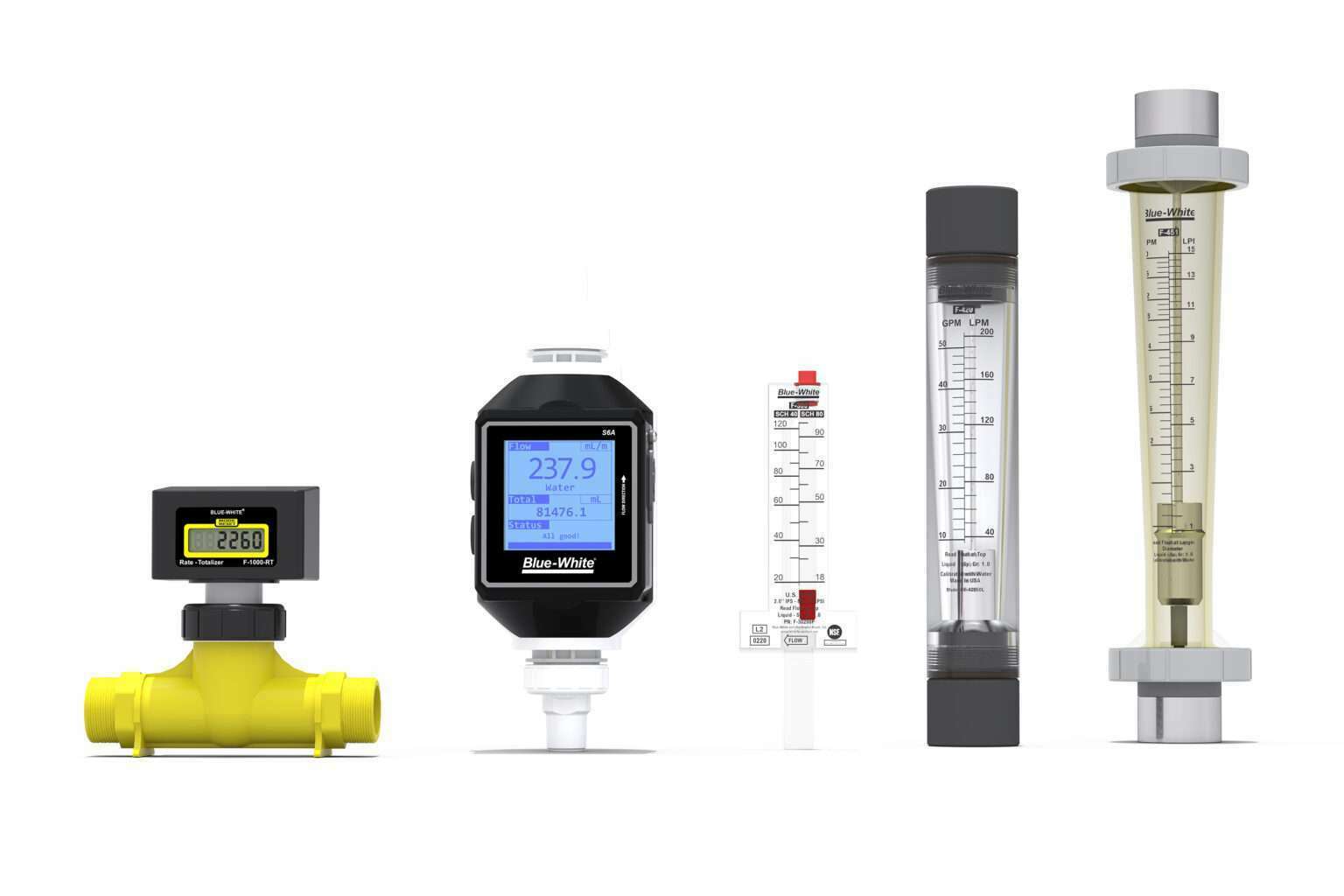
artPaddlewheel
Home  >> Products  >> By Manufacturer  >> Blue-White  >> articles  >> artPaddlewheel  >>


Custom Search

Call For Quote 1 800 230-1426

Live chat by BoldchatPlus
Live chat by Boldcenter


          Proud Members of:


AWT Logo Sm1


 Pump Training

Home   |  Pumps  | Flowmeters  | Tank Systems   |  What's New?  | 

Paddlewheel Flowmeters
And why they are popular


Cost  of accuracy

 Those of us in the  instrumentation industry know there is a simple rule; if you want higher  accuracy, it will usually cost more money.  Paddlewheel Flowmeters come  very close to dispelling that rule. Due to modern technology, advanced  plastics and metals, solid-state circuitry, and good old capitalism the  high cost of accuracy has been challenged.  With the use of  computer-enabled testing facilities, paddle sensors are individually  bench tested and are accurate to within 1% of the full scale range  reading. The sensor's flow parameters are then printed and packed with  that particular Flowmeter. The key is the use of technologies that were  simply not available some years back. It is important to note that  although the paddle sensor is tested, and accuracy confirmed,  installation variables can affect the meter's ultimate performance. But  that would be the case with most types of Flowmeters.  Dollar for  dollar, the paddlewheel Flowmeter simply gives you hands down, more  accuracy for your dollar.

Ease of installation

 Comparatively speaking, paddlewheel Flowmeters have distinct advantages  over many kinds of Flowmeters. Paddlewheel style Flowmeters can be  installed either horizontally or vertically, with flow in either  direction, without compromising overall meter performance. Paddlewheel  Flowmeters can be purchased complete with a sensor, digital display and  in-line meter body (pipe fitting) which can be easily installed into a  piping system.  You can also purchase the meters with saddle mount type  pipe fittings which are very convenient for installation on existing,  larger pipe sizes where in-line fittings are prohibitive.

Battery or AC operated

 Today's Paddlewheel Flowmeters use advanced solid-state circuitry which  can operate on common batteries eliminating the need for electrical  connections. The technology has advanced to the point where batteries  last for a minimum of one year. When the batteries are replaced, no harm  is done to the factory settings.  Paddlewheel Flowmeters have  considerable capabilities such as batch process control, analog output  signals and remote readouts. These full featured meters require a power  source and are typically supplied with an AC/DC plug-in style  transformer. Keep in mind the flexibility this meter offers the user.

Versatile meter

 Paddlewheel Flowmeters are deserving of the attention they are  receiving. While most applications are with water, paddlewheel meters  also work remarkably well with viscous fluids, provided a fully  developed turbulent flow profile exists. If the fluid's Reynolds  number is greater than 4000, the fluid we be a fully developed  turbulent flow regardless of viscosity changes.

REYNOLDS NUMBER  EQUATION

7741.92 x ID x V
Cst

 Where:
ID = the pipe inside diameter in inches
V = the flow velocity in feet per second

Cst = the fluid viscosity in centistokes


 To maintain accuracy, the Reynolds number must be above 4000 over the  entire flow range. Unlike variable area meters, paddlewheel meters are  not affected by changes in the fluid's specific gravity. Special  calibrations are not necessary.

 Another compelling reason people are turning to paddlewheel  style Flowmeters is their ability to have a remote readout. Paddlewheel  Flowmeters easily permit the panel mount readout to be installed in the  most desirous area, while the actual sensor is installed in an obscure  area of the pipe system. For example, in any application, the paddle  sensor can be installed in the proper location and the digital display  can be remotely located in a more desirable location in the system such  as on a centralized control panel.

Maintenance

 The meter's paddle and axle are in direct contact with the fluid. Since  the paddle will spin at a velocity that is directly proportional to the  rate of flow, these components will wear over time. Meters which are  operated at the high end of their calibrated flow range will tend to  wear more than units operated at the low end. Because every fluid has  different characteristics, it is difficult to estimate the life  expectancy of these components. Some water (DI water), may be very  aggressive while some water may be exceedingly hard or full of  abrasives. The resistance of the components to the chemical being  measured should also be considered. Axles and paddles are easily  replaceable. A neglected paddlewheel Flowmeter will in time have  degraded accuracy.

             The maintenance factor should not in any way deter using  paddlewheel meters, just remember, turbine meters have the similar  problems; rotameters also have to be maintained.  This is a case where  the benefits far outweigh the cost.

Maximize paddlewheel  performance

 If your flow falls below one foot per second you should expect  some accuracy challenges.  Avoid using paddlewheel Flowmeters for  measuring very dirty fluid, or liquids with rocks or pebbles that could  break or damage the paddle or axle. Follow the manufacturer's  installation recommendations regarding straight lengths of pipe.  If you  cut corners, do not expect optimum performance from your meter.

In summary

 Paddlewheel Flowmeters should be considered by anyone who requires above average metering accuracy where cost is a consideration. These  meters are also recommended because they are easier than most meters to  install, can measure flow in either direction and serve the intended  purpose of measuring flow.  Considering the overall cost of  ownership, it is very difficult not to consider the paddlewheel  Flowmeter.

 Following are some terms you might find useful. The more you understand  how and why a Flowmeter works, the greater success you will have with  your selection.

 K-Factor – The number of signal pulses generated per  unit volume of flow. Example: 225 pulses per gallon.

 Reynolds Number – A dimensionless number that combines the  effects of viscosity, density, and flow velocity which is used to  identify either a turbulent or laminar flow profile.

 Specific gravity- (relative density) The ratio of the  density of a fluid, at it's temperature, to the density of water at a  specified reference temperature.

 Feet per second of flow – The velocity of fluid flow in a pipe  expressed as the number of linear feet of flowing fluid passing a given  point in a pipe, per one second of time.


Cannon Water Technology Inc. All Rights Reserved © 1999 1 800 230-1426